Tips for negotiating car prices, including trade-ins and financing


Online calculators to determine the house, car in your budget
These easy tips can help you figure out a budget if you’re considering buying a house or car.
Problem Solved
- Negotiation doesn’t have to be painful if you follow these tips.
- Treat a car purchase like any serious financial transaction: Do your research, make an appointment and do not purchase on the day you shop.
- Know your credit score and come prepared with financing.
- There are other negotiating tools beyond bickering over the price of the new vehicle or a trade-in.
So it’s time to buy that next vehicle, and while you might be eager to climb inside a stylish new car for that fun test drive, we all know what comes after: The dreaded negotiation on price.
Car buying experts said most consumers dislike having to negotiate on price, always feeling like maybe you left something on the table in terms of what you get for your trade-in, or you paid more than your neighbor did for a similar vehicle. Plus, it can be downright awkward to do.
“We’ve done research and found that for most consumers, negotiation is a pain point they’d rather not deal with,” said Brian Moody, executive editor for the car shopping site Autotrader. “One woman told me, ‘I don’t care if it’s the absolute bottom price or not, as long as they treat me well and I’m done quickly.'”
Moody said for people who detest negotiation there has been a rise of no-haggle dealerships, where the prices are fixed. But if you’re not going to one of those dealerships, the truth is you will need to negotiate.
To ease the process, Moody recommends to straight-up tell a sales person in the beginning: “‘I’d like to pay this amount,’ or if you’re leasing you can say, ‘I’d like to pay less up front and have a bigger monthly payment’ or the opposite. That’s all negotiating. All they can do is say no.”
You are the customer and you are in the driver’s seat, he said. You might not achieve a perfect negotiated deal, but you can at least feel good that you did the best you could if you follow some tips the experts say can help you negotiate like a pro the next time you buy a car.
Treat the transaction as you would any big purchase
Moody said to think of buying a car the same way you would any serious financial purchase. That means research it first, make an appointment and never buy on the same day that you shop.
“Before you go to a dealership in person, you should know quite a bit about the two or three cars you’re serious about,” Moody said. “That’s from online research, talking to neighbors and reading reviews.”
Also have the right mindset, said Ivan Drury, director of insights at Edmunds.com.
“You need to go into a negotiation with whatever makes you most comfortable. Have your favorite breakfast, hit the gym beforehand, go on a hike, watch your favorite Wall Street movie,” Drury said. “Whatever it is that puts you in the right space mentally to deal with a situation that involves making tough decisions, that is where you want your mind to be.”
Establish a contact person at a dealership with an email or a phone call and then make an appointment with them. And remember, you wouldn’t buy a house the same day you viewed it, so you should not buy a car the same day you shop for it, he said.
“Shopping is looking. I’m gathering information and research,” Moody said. “Buying is the day you are going to buy the car, and that’s when you can worry about negotiating the price, the color and all that stuff.”
The dealer is not doing you a favor by selling you a car, and you are in control, he said. Moody advised assertively saying, “today is the day I’m shopping and not buying the car.”
That allows you to keep your emotions in check, think it out and compare all your options. You want to view and drive two or three other cars like it, all to make sure you’re making the right long-term decision.
Arm yourself with knowledge and be organized
Drury said it is critical to get as many comparable prices as you can on the vehicle you want and make sure they’re current.
Automakers change their incentives on vehicles every month, Drury said, and they are not specific to the calendar day. They’re on a sales day calendar, which has beginning and end dates that you won’t be familiar with, so open up the details of any incentive to find out the actual end date.
“Be organized,” Drury said. “It is easier to negotiate when you have all your paperwork in order, websites with calculators saved in one place, etc. Fumbling around looking for important things or trying to recall specific numbers in a high-pressure situation isn’t confidence-inspiring.”
He suggested printing some things out because flipping to specifics on paper is easier than showing someone something on a 6.5-inch screen.
Moody agreed, adding that research on incentives is crucial given all the tariffs or other global events that could impact pricing.
“You can’t say, ‘All Buicks are expensive and Nissans are not.’ It’s model by model. For example, Ford has its employee pricing through early July, but if you look at the small print there are many models that don’t apply. Nissan has actually lowered the prices on two of their cars, which is counterintuitive to what’s happening right now with tariffs. But Nissan makes a lot of their cars in the U.S.”
Therefore, know what incentives and lease deals are available in your region. It’s possible you’ll get a better deal than the national deal and it’s also possible they’ll say, “We’re not doing that program,” and you won’t get the deal that was advertised.
Questions to ask about financing
If you can afford to pay cash for a vehicle, that’s the wisest thing to do, Moody said. Unless they are offering 0% financing, then take that. There are some 1.9% and 3.9% financing deals out there as well that are good, and always take the shorter loan term because you have equity in the car sooner, he said.
You should note that the interest rate for a loan to buy a used car will typically be higher than the interest rates for loans on new cars. The experts said, for that reason, if you’re looking for a lightly used, newer model pre-owned car, it’s smart to look at a new car, too. If you get a lower interest rate on new car financing, it might make more sense to buy the new car.
Be armed with your credit score, Moody said. In fact, it is best to get pre-approved from your bank or credit union before negotiating on a car. While most dealerships have deep partnerships with many banks and will probably get you a better interest rate than your bank or credit union, there is a chance they might not. Which is why having a backup loan available is key.
Once the dealership gives you a price quote, ask for a printout of the exact numbers, fees and taxes so you can take it home and study it.
“Ask them: Is this the lowest interest rate that I qualify for?” Moody said. “Is the dealership adding any extra points to the loan? Is there a lower trim level that fits into my price level more?”
Trade-ins as a tool
Drury said your strongest negotiation tool might also carry the most variability: The vehicle in your driveway that you plan to trade in.
“It is imperative that you get it appraised from multiple buyers before you go to the dealership,” Drury said. “You want paperwork or emails that show what others are willing to pay. If you are fortunate enough to live in a state with a sales tax reduction through trade-in, get ready to do some math on how much lower of an offer you can take but still break even with tax savings accounted for.”
If a dealership can come close enough on the trade-in value, then sometimes it makes sense to perform the transaction all under one roof, Drury said. But getting the most for your trade-in can bring down your payments on the new vehicle.
No trade in? No problem, said Moody.
“If it’s a negotiating dealership you can always say, ‘I’d rather put this much down and pay this much a month.’ It’s always better to shop not by monthly payment,” Moody said. “I can sell you a Maserati for $300 a month, but it might be a terrible deal if you don’t know the rest of the terms. It could be for 1,000 months. You want the lowest down payment, lowest monthly payment and shortest months as possible.”
How to handle a lease
When buying a car, a general rule is to put as much money down as you can afford to do — unless it’s a lease. The most a person should put down on a lease is the most they can afford to give away because that money is not coming back to you, Moody said.
Also, the longer the lease contract, the lower the monthly payment will be, so do as long of a lease as possible.
If you’re torn between whether you should buy or lease, Moody said, “I always say the financially the wise thing to do is buy. But there could be circumstances where leasing is an advantage, but leasing repeatedly and you lose money.”
OK, you might ask, but when the lease is up, should I buy the car?
“That’s a tough one,” Moody said. “A lot of places say no. If you can afford to pay cash, do it. I did that once and it worked out well for us. But if you have to borrow money, now you’re borrowing money on what you know is a good car, but now you’re just spending more money on top of what you already spent money on. It might be better to turn it in and then buy a brand new car at a higher monthly payment.”
The finance and insurance office
So you’ve selected the vehicle you want to buy or lease and now comes those extra add-ons such as wheel and tire protection, an extended warranty or key fob insurance. All of those are presented to you in the finance and insurance office where a manager presents you with a million pieces of paper to sign to seal the deal.
Here’s the thing: Moody said the negotiation is not over just because you are now in that office.
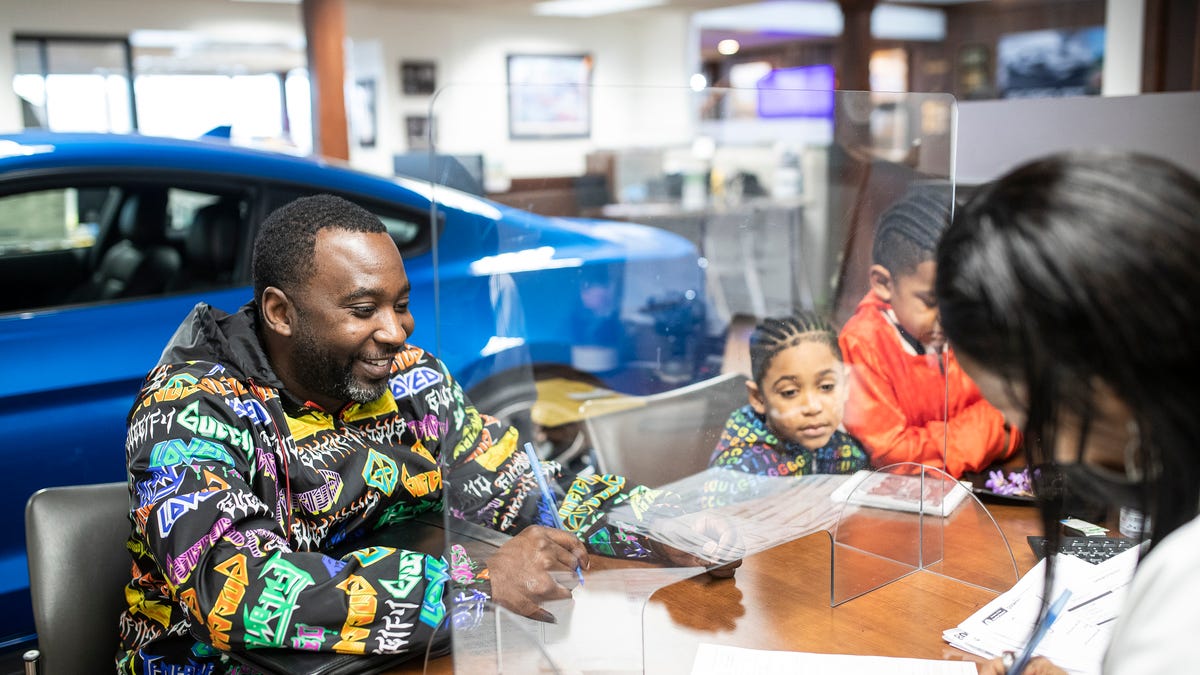
“When you’re saying the word ‘negotiate,’ most people assume you’re only going back and forth on the price of the car,” Moody said. “You can say, ‘Can I get tire and wheel protection for free as part of this deal?’ or ‘Can I have the first three oil changes for free?’ or ‘A free car wash every time I bring my car in?’ That’s still negotiating. You can also still say, ‘I need more for the trade in.'”
All of that is part of negotiating even though it is not directly touching on the price for the car.
“The (finance and insurance) experience, that person you talk to after the sales person, you’re still in a sales environment. Meaning they are still trying to sell you things,” Moody said. “So have the same level of diligence and have your antennae up as you would when you’re talking about the price and interest rate.”
Some of the products sold in finance and insurance are worthwhile. For example, if you live in a region where the roads are bad and you can blow a tire frequently, negotiating a free year of wheel and tire protection as part of the purchase could pay off if you need to replace a couple of tires and it saves you $500.
If you are buying an electric vehicle, find out what kind of charging cable is included and use that as a negotiating tactic.
Don’t be afraid to ask, or leave to clear your head
Drury reminds consumers that the better prepared you are, the more efficient your time in the dealership will be spent and the faster you can be in and out with a deal you’re happy about. But remember, it is OK to ask the dealership sales people lots of questions.
“You only buy a car once every couple years and the market has certainly changed, don’t be afraid to ask questions, anything from a vehicle’s features all the way down to what does a certain fee cover or anything in between,” Drury said.
Also, he said, dealerships buy and sell cars everybday, so they might use acronyms or financial verbiage you’re not familiar with. He said most dealership personnel don’t use those terms to trick you, but rather because it’s just become commonplace for them. So if you don’t understand what they said, speak up.
“Better to ask today versus Google it later and find out you shook your head up and down when you should have gone left to right,” Drury said.
Finally, he said, while it is never good to get emotional during a car purchase, it happens.
“Maybe you don’t like the trade-in offer, the incentives you want aren’t combinable, whatever it is, don’t let these things derail a negotiation,” Drury said. “But if things get a bit too heavy or you need some time to think, always feel free to leave (unless those incentives are expiring, then you’re rolling the dice) to clear your head.”
Jamie L. LaReau is the senior autos writer who covers Ford Motor Co. for the Detroit Free Press. Contact Jamie at jlareau@freepress.com. Follow her on Twitter @jlareauan. Sign up for our autos newsletter. Become a subscriber.
link