From Sports Gear to Fashion Accessories
Japan’s manufacturing is renowned for its dedication to craftsmanship. Over the years, Japanese manufacturers have been able to combine functionality, high-quality materials, and continuous innovation. How would you define the uniqueness and main strengths of Japanese lifestyle goods and manufacturing?
I believe Japanese people are deeply committed to craftsmanship, or what we call monozukuri, and they strive for perfection. This dedication is one of the main strengths that contributes to the overall success of companies. Additionally, I think Japanese people have a unique sense of design, which further enhances the appeal and functionality of our products.
One of the biggest challenges facing Japan is the declining and aging population, which is creating dual pressures for Japanese companies: a shrinking domestic market and difficulties in hiring staff. How is your company responding to these challenges, and to what extent do you believe expanding into international markets will be key to securing long-term success?
Our main business revolves around baseball gloves, and fortunately or unfortunately, our primary target market is the U.S. The baseball-playing population there is relatively stable, so we do not expect significant growth in that market. In Japan, as you mentioned, the declining population is affecting our business. Overcoming these challenges will be difficult for any single manufacturer to achieve on its own. However, as an industry, I believe everyone in Japan is working to boost the popularity of baseball, and we are doing our part by collaborating with those efforts.
As the birth rate decreases, we’ve noticed that sales of high-end products are actually on the rise. In the past, lower-end products were more popular, but this has shifted as the population declines. To continue receiving orders for high-end products, we need to not only maintain our technical expertise but also keep our prices competitive. A lot will depend on how successfully we can sell these higher-end items. Additionally, since we manufacture overseas in the Philippines and Vietnam, our competitors are also Japanese manufacturers. Despite being Japanese myself, I find that I’m competing against Japanese-made products.
Has your company considered creating your own made in Japan brand?
We have never considered launching our own made-in-Japan brand for baseball gloves.
In the past, we had a factory in Japan, and I have considered bringing craftsmen from the Philippines and Vietnam to Japan if needed. However, at this moment, I don’t think that’s realistic. That said, with the current depreciation of the yen, it could become a more feasible option in the future.
Speaking of your production capacity, you hold the larger market share, catering to everyone from Major League Baseball players at the highest end to middle-level players and even sandlot players. What is it about your production methods and expertise that has allowed you to capture and maintain such a large market share for so long?
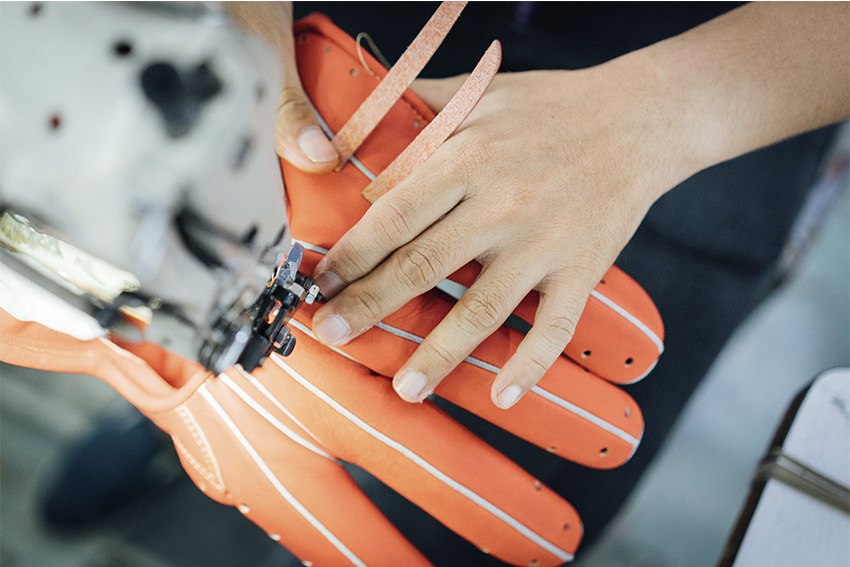
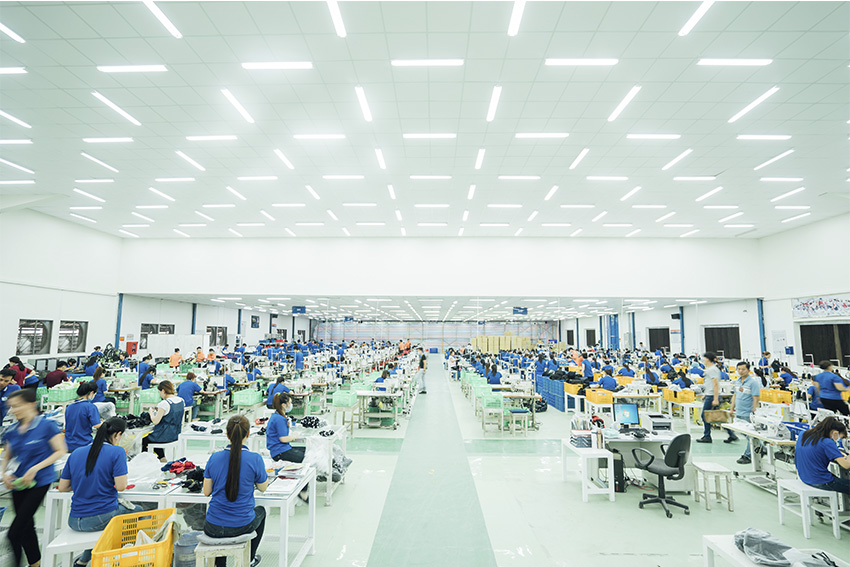
We established our factory in the Philippines in 1987. Initially, baseball gloves were handcrafted, but we later industrialized the process and brought that capability to the Philippines. In the past, craftsmen relied heavily on knowledge and experience. However, today, we’ve shifted to industrialized processes, and I believe that’s one of our company’s key strengths.
With over 1,600 staff members overseas and your OEM production capabilities, you’re able to cater to large multinational companies. Do you also offer high-mix, low-volume production of specialized products?
The 1,600 people represent the total workforce across all of our businesses, not just baseball gloves. Our manufacturing operations are broadly divided into three categories: custom production, mass customization, and mass production. The factory in the Philippines mainly handles custom production and mass customization, while our facility in Vietnam focuses on mass production. In recent years, however, the Vietnam facility has also begun expanding its capabilities in custom and mass customization production, particularly for ice hockey and lacrosse gloves.
Could you provide an example of a customized or low-volume production solution that you’ve offered to a client?
We provide customized products based on individual customer requests. For fully custom orders, we can produce even a single glove, allowing customers to choose from dozens of patterns and customize materials, stitching, design, and colors. In addition to full customization, OEM mass customization through SMU (Special Make-Up Unit) orders has been increasing, as customers tend to define their own detailed specifications more freely. At the same time, the minimum order quantities for SMUs have decreased—from around 100 to 300 units in the past, to now as few as ten. This trend has made flexible and detailed mass customization more essential than ever.
You have professional players using your equipment, and I imagine they provide feedback to the equipment provider, which eventually makes its way back to you. However, you might miss out on some direct feedback. You also offer mass-market gloves for amateurs. In terms of the feedback process and product development, is there a way for you to gather more direct feedback from your customers?
Currently, we primarily receive feedback through the brand representatives from the companies selling our products, so we have limited opportunities to gather direct feedback. In the past, we would visit professional players at their training camps alongside the brand representatives, allowing us to receive direct input. However, now we only hear feedback through our partners.
You mentioned that baseball is your core business, but you’ve also expanded into boxing, lacrosse, and hockey, while the baseball market in the U.S. has remained flat. Looking ahead, is there another sport or application you’re considering expanding into?
Cricket has been considered since it also uses gloves, but the biggest markets are in India and Pakistan, where price competition is incredibly fierce. As a result, we’ve decided not to pursue that market segment. However, given our technology and capabilities, we’ve successfully expanded into the other sports you mentioned.
Actually, some of our expansion, like into boxing gear, was a result of the China tariffs imposed during the first Trump administration. Many customers who were sourcing from China started looking for alternative suppliers and then reached out to us. We saw an opportunity in that market, which is how we got started in that area.
Do you expect more positive developments with this administration?
I’m not sure what to expect. Everyone is concerned about his policies and what might happen, especially regarding trade and tariffs. Even if production shifts to other countries in Asia, I don’t believe there would be significant advantages in terms of tariffs.
One theme of our reporting is upcycling and using sustainable materials. Regarding your bag division, we understand you’ve been exploring the use of leather offcuts from glove manufacturing for your bags. Can you share how this idea to shift into bags came about?
The concept is quite simple. In Japan, we have a word, mottainai, which expresses a sense of regret about wasting resources. It’s a cultural value. With baseball gloves, the shell palm is crucial for catching the ball, so it must be made of leather. However, during the glove manufacturing process, a lot of leather goes unused, and we didn’t want to waste it.
These days, upcycling has become a popular term, but for Japanese people, the spirit of mottainai has long been part of our culture. It’s always been about using everything we can. In line with this spirit, we decided to repurpose the leftover materials and create something new. That’s how we ended up making bags, and we’ve been using all of our materials in this way for a long time.
Speaking of your bag business, you’ve traditionally been a B2B company, but now you’re offering your bags through a B2C model as well. Looking ahead, is B2C something you’d like to expand upon with your bags, and do you see this as a business you could take to overseas markets?
Our bag lineup is divided into three main series: the GLOVE series, which features designs inspired by baseball gloves; the PANEL series, which upcycles leftover leather from glove production; and a range of business bags made from glove leather. We believe each of these series offers unique products that only we can create.
Our goal is to first expand into Asian countries where daily lifestyles are similar and where baseball is popular. However, since our brand recognition is still limited, we are currently prioritizing efforts to raise awareness in the Japanese domestic market before expanding overseas.
One thing that I found interesting about your overseas factories in Vietnam and the Philippines is that they don’t just make products for your company. They also take on their own projects. How do you see this relationship developing? Do you see your overseas production eventually becoming something that produces goods independently for specific markets?
We are a group company, so we collaborate with each other. For instance, ice hockey gloves are made in the Philippines and sold by the local organization there, without the involvement of our headquarters. The same applies to the boxing gear made and sold by our Vietnamese affiliate. Our goal is for these affiliates to not just function as factories, but to operate independently. Of course, if there are better opportunities to collaborate, we will pursue those as well. Baseball gloves and bags are managed here at the headquarters. I believe this kind of structure and mindset sets us apart from companies that view their overseas factories solely as manufacturing sites.
Looking at your overseas expansion, you already have strong OEM partnerships, especially for your baseball gloves in the United States. Are you looking for more such partnerships?
At this stage, we have no intention of expanding our OEM partnerships for the same product category. In the U.S. baseball glove market, we have built a relationship with our client over the past 60 years, and our focus is on evolving and continuing that partnership. Of course, the limited size of the market is one reason, but more importantly, we prioritize quality, trust, and long-term continuity over simply scaling up.
We take the same approach in our lacrosse and hockey businesses. This may differ from the mindset of large OEM manufacturers that produce items like sneakers, but we believe this is what sets us apart.
Regarding your B2C brand, are you interested in forming partnerships with retailers or local agents in overseas markets to help connect with retailers?
We are definitely interested in forming partnerships for TRION’s bag products in overseas markets, but we are still in the early stages of conducting research outside of Japan. While it’s important to highlight the unique design and high quality of TRION bags, we also believe that sharing the story behind the brand and our company will help others truly understand what makes us different. By communicating both the product value and our background, we hope to build meaningful and lasting relationships with local partners.
Is Japanese quality not appreciated in these markets?
The quality is appreciated, but based on my experience in the mass market, the challenge lies in the pricing versus quality balance, which makes things difficult for us.
Imagine we return to interview you again on your last day as the president of the company. What personal goal or ambition would you like to have achieved by that time?
Of course, I want to pass on a healthy business to the next president, particularly the mindset and company spirit. I hope to see someone succeed me before my career ends. I also want to ensure that the businesses in Vietnam and the Philippines remain sustainable. This industry has often shifted manufacturing sites, especially for handcrafted products, due to intensifying competition. However, I believe there’s no end to this cycle, which is why I want the Philippines and Vietnam to be able to operate independently. I believe glove manufacturing will remain our core business. At the same time, rather than simply pursuing scale, I hope we can grow by valuing our teams in the Philippines and Vietnam, and by staying close to the lives of the people who use our products.
For more information, please visit their website at: https://trion-net.co.jp/english.html
link