News and Notes from Milan Fashion Week
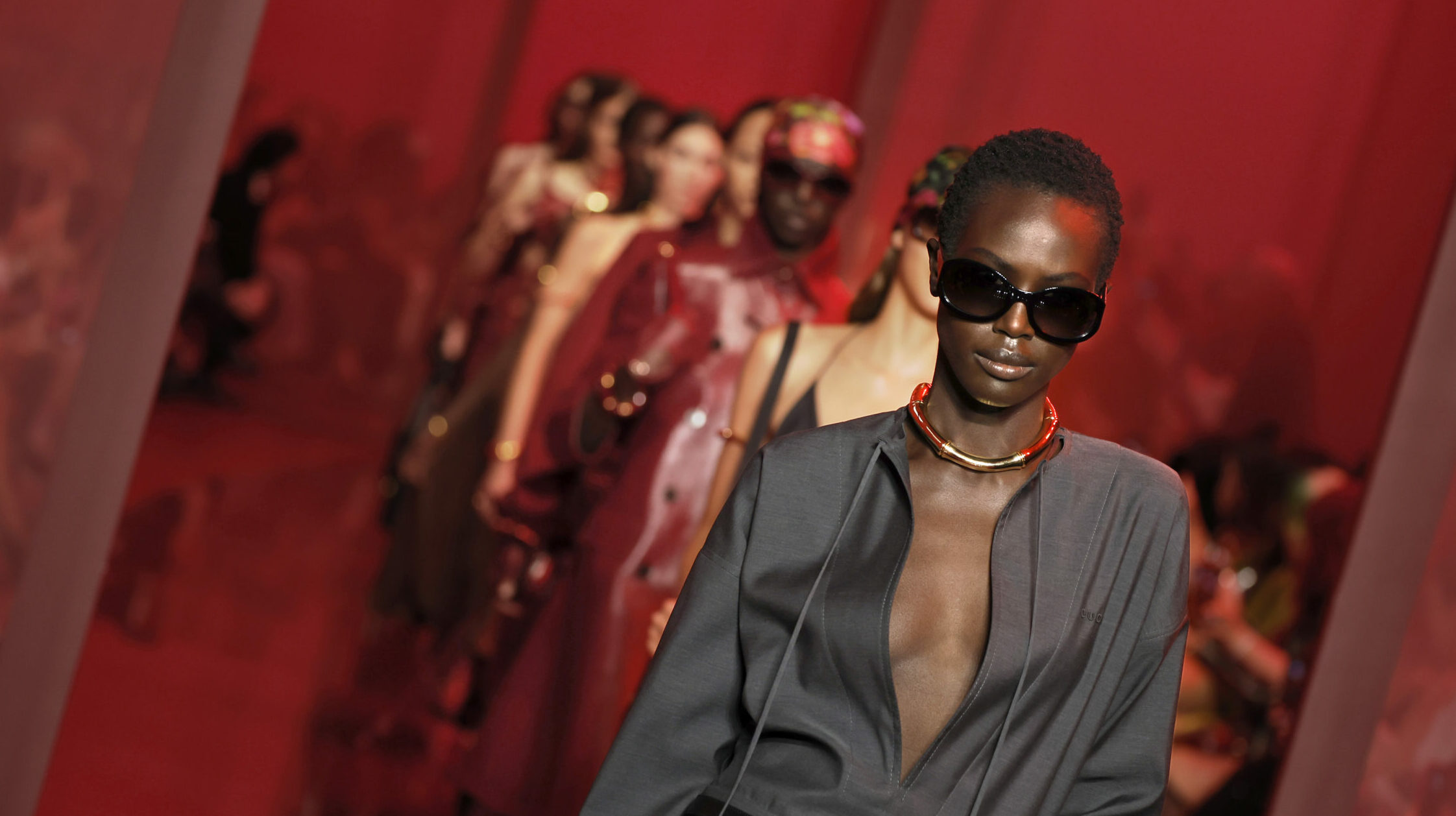
The question everyone was asking me in Milan, all weekend, was whether or not Friday’s Gucci show was Sabato De Sarno’s last. My honest answer is that I truly do not know, and I’m pretty sure most people, even executives who work at Gucci, feel the same way. Yes, De Sarno’s name is on the invite for LACMA’s annual Art + Film Gala, which takes place on November 2, but that only means a little.
For what it’s worth, I thought that his latest collection was once again a marked improvement from the previous one. His big idea (i.e., Let’s have fun in cute clothes) was more fully realized, assisted by new stylist Marie Chaix, who appears to be a better match than former stylist Alastair McKimm, who was off helping creative director Adrian Appiolaza sharpen up Moschino. (They succeeded, by the way.) Of course, the industry sentiment around De Sarno matters far less than whether the collection sells. On the runway, the greatest strength was in the shoes, especially the clear-wedge platforms, which you don’t have to love to know that they will work at retail.
What about De Sarno’s neat coats, tulip-skirt sets, ribbed tanks, and wide-leg jeans? Maybe, but remember that Gucci is a global brand that needs to win back consumers in Asia as much as in the U.S. and Europe. Parent company Kering, whose latest results will be released on October 24, recently saw its shares plunge to a seven-year low on analyst reports of soft consumer trends in China.
The other priority for Gucci is restructuring the business, which has changed dramatically during the past year. It was only in July 2023, after all, that Marco Bizzarri was fired. Less than two months later, U.S. deputy Susan Chokachi left the business. (They are now investing in new brands together through Forel, Bizzarri’s fashion and luxury firm, which is linked to Faro Alternative Investments. They were holding court at the show of Elisabetta Franchi, their first buy-in, on Friday night.)
After Bizzarri and Chokachi left Gucci, many more executives followed, and a new management structure was implemented a few months ago. The people at the top—C.E.O Jean-François Palus and deputy C.E.O. Stefano Cantino—are surely still working through the reorganization. As one person close to Kering said to me, De Sarno has the ingredients, but there’s been operational upheaval since the moment he arrived. Now he’s presumably getting the support he needs, but is it all too little, too late?
What People Want
Saturday’s Bottega Veneta show made it feel like Matthieu Blazy is only just beginning. Backstage, where Blazy made an effort to make eye contact with every single journalist in the very civilized scrum, he spoke about little children dressing like grownups, coming of age, and the romance of the first-interview dress. Working Girl, the old Melanie Griffith movie, often bubbles up in my mind during Blazy’s shows, and not just because there’s a bigness to his work—big shoulders, big hair—but also because there’s an innocence and humility. (I enjoyed his depiction of the disheveled dad at school dropoff, carrying a cotton tote and wearing a screwed-up tie.) Blazy designs with good intentions. I was particularly taken by the tropical wool used in several looks—it was made with a bit of stretch to look elegantly rumpled.
It’s been a pleasure to watch his unfolding vision for how we should, or could, dress. And it’s Kering’s job to make sure people buy into this world through merchandising Bottega’s stores correctly, but it’s Blazy’s job to inspire. Bottega ambassador Julianne Moore called the collection “deeply felt, romantic and human,” on Instagram and honestly, she nailed it!
The other big win this past weekend was at Bally, where designer Simone Bellotti once again exhibited a talent that does not know the bounds of a brand. He is undoubtedly being considered for bigger jobs, given what he’s been able to cook up in three seasons at the Swiss house, which recently changed hands over to an American investor. More on that sooner than later, I’m sure, but for today, let’s talk about the clothes.
Bellotti mentioned that he was thinking of the silhouettes of Romeo Gigli, a clue that might explain why so many fashion people are smitten with his work. (Gigli is a big inspiration for The Row, among others, and is a current favorite on the overpriced vintage circuit.) His intention with the “project,” as he calls it, was to suggest that Swiss-ness wasn’t just about “banks, chocolate, and precision,” even if his work is indeed very precise. For the collection, he once again played with the idea of a bell curve, this time on the hem of denim jeans. The black leather, the boat shoes, the red bags: pretty, but a little nasty, and a tad off. Kind of what Audrey Horne would wear if the original Twin Peaks were set in 2024. It’s what we all want right now.
Loro Piana, too, is making things people want. I hear the bags are selling like crazy, but the brand’s success is less about the wretched concept of quiet luxury and more about the specificity of everything they do—from the color choices (soft, but not dusty, shades) to the silhouettes (the pant shapes and necklines are so uber-traditional and purposefully stuffy that they nearly look rebellious). My theory is that Loro Piana has prospered as it moves further into leather goods and true fashion because its underlying business is textiles. The support of the LVMH infrastructure doesn’t hurt, either.
Watching the Tod’s and Ferragamo shows this past week, however, made me think about how hard it is to turn a shoe brand into a clothing brand. I thought Tod’s designer Matteo Tamburini’s second collection was nice—made nicer by Brian Molloy’s styling proclivities—and that this Ferragamo show was Maximilian Davis’s best to date. (The raw edges on some of the pieces, and the edgeless swirls of rope on others, were two of my favorite elements.) And yet, I don’t know if I see a person looking to become a Tod’s woman or a Ferragamo woman. I’m not sure if that’s simply a matter of history or a matter of resources.
On the other hand, we know who the Versace woman is. Donatella Versace is the master and muse, and the brand’s ’90s archive-inspired collection reflected that. The show, itself, felt smart and commercial but also appropriate given the situation that parentco Capri finds itself mired in with the stalled Tapestry merger: Nothing can really change until everything gets unfrozen. But, as with Michael Kors, once the deal goes through (or doesn’t) we have to demand more.
Italian Jobs
In Italy, though, it always comes back to the fate of the independent brands. Going it alone feels less tenable than ever, and given the softness in the market, there are people with money to spend on good-value deals. Will Renzo Rosso scoop something else up? He’s sure made a case over the past few years that he’s willing to give the artist some rope. The star example is Glenn Martens at Diesel. There was a hypnotic soundtrack running through the entirety of the show where the narrator kept saying things like, “Enjoy denim. Enjoy indigo. Enjoy Diesel,” a comment on propaganda while being propaganda. Personally, I enjoyed the way all the looks sort of whipped around the body.
Armani remains independent, even though there are dozens of, if not more, investors who dream of buying it. The season’s Emporio show was a sort of teaser for the big collection show occurring in New York in October. The thing a lot of these stalwart brands, like Armani, is that their fashion proposal remains unchanged. Some seasons that’s bothersome, other times it’s not. This time at Emporio, the jaunt around the venue in cropped jackets and billowing trousers was warmly received. (As were Mr. Armani’s own navy sweatpants, only rivaled by Ralph Lauren’s vintage denim.)
At Dolce & Gabbana, the homage to the Jean-Paul Gaultier era of Madonna—who sat in the front row, by the way, covered in a black veil as if she were attending her own funeral—was perhaps not the designers’ best version of themselves. Anyone who cares to deeply criticize the clothes on a Dolce & Gabbana runway is going to have a tough time: The reason the company has been so successful, besides its hit fragrances, is because people actually buy the clothing. I’d reckon the percentage of repeat purchases is far higher than most brands. (Women collect these dresses because they fit like a dream.) That said, the homage to Gaultier felt hokey at times.
In Italy, however, everyone is talking about Dolce & Gabbana for another reason. Will Domenico Dolce and Stefano Gabbana finally sell? As with most of these companies, the designers have previously denied interest in raising outside capital… but it’s impossible not to consider an exit as they ponder the future. In 2022, the brand brought its fragrance and beauty businesses in-house—a bold move for an independent company that could reap more profits in the long run, but nevertheless a major cost in the short run. If a deal is to be done, I could see them looking to partner with someone outside of Italy. Maybe even as far away as China.
link